LoveAndFreedom…
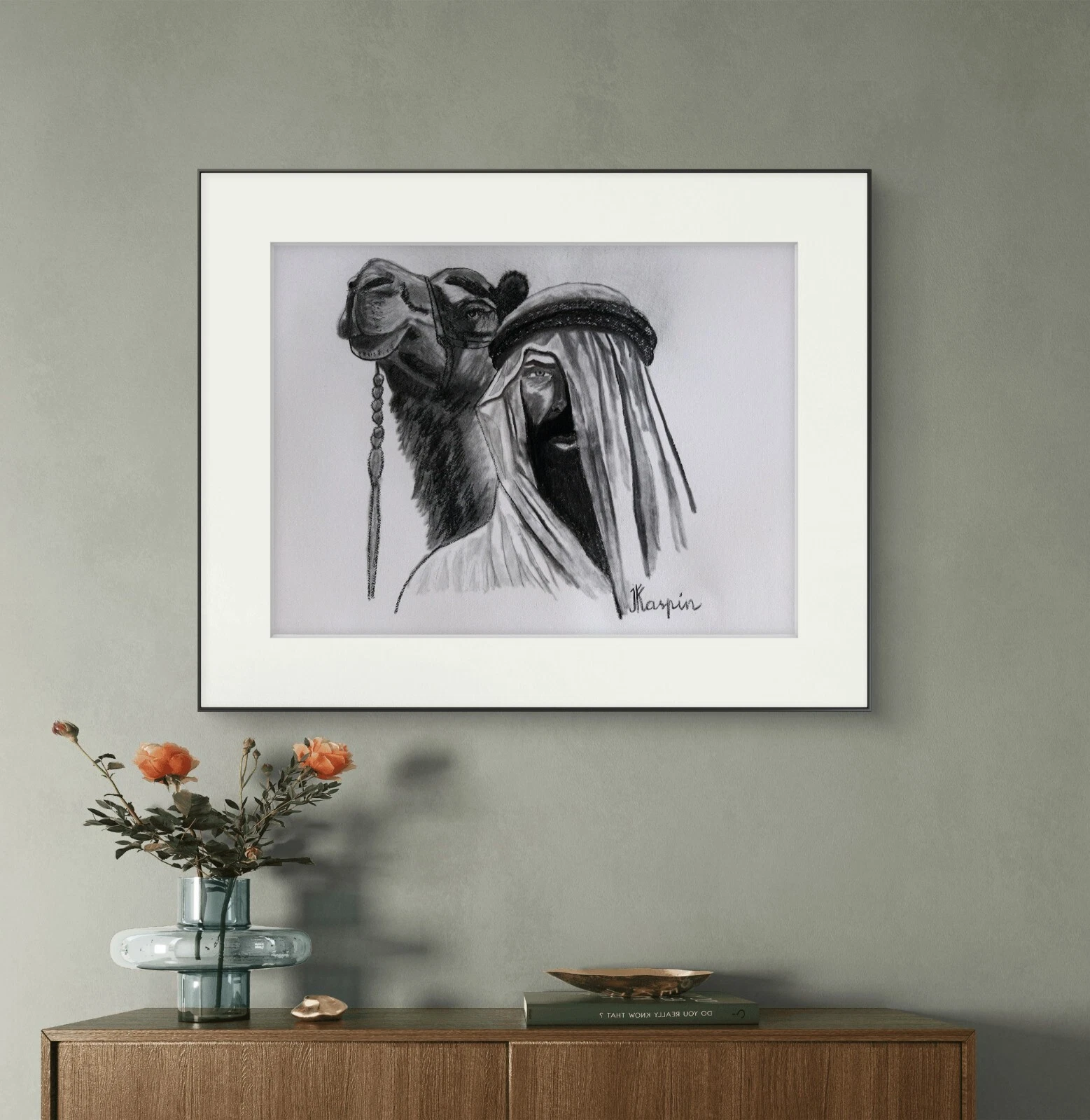
Le vent glissait sur les dunes comme une caresse oubliée. Le soleil, déjà bas, peignait l’horizon de teintes d’ambre et de cendre. Il marchait lentement, son keffieh flottant derrière lui, guidant son fidèle compagnon, un vieux dromadaire au regard sage. Ensemble, ils traversaient le silence du désert, non pas pour fuir, mais pour se souvenir.
Elle s’appelait Layla. Une étoile parmi les grains de sable. Ils s’étaient rencontrés dans un souk vibrant de couleurs et de parfums, là où les voix s’entrelacent comme des fils d’or. Elle lui avait parlé de poésie, de l’amour comme d’un mirage : visible, mais insaisissable. Il l’avait aimée sans la posséder, comme on aime le ciel — avec respect et vertige.
Chaque soir, il revient là où le vent murmure son nom. Il parle à son camel, comme on parle à un vieil ami, partageant les fragments de mémoire que le cœur refuse d’oublier. Le désert ne répond jamais, mais il écoute.
Et dans ce silence, il trouve une forme de paix. Car l’amour, quand il est vrai, ne s’éteint pas. Il devient sable, vent, lumière — une présence invisible qui veille.
MurMures sous les dunes
Sous le voile des cieux désertiques,
Où le silence chante des chants antiques,
Il marche seul, l’ombre en arrière,
Son chameau fidèle, témoin de ses prières.
Le vent murmure un nom jadis doux,
Un amour perdu dans l’éclat des cailloux.
Ses yeux, étoiles dans la nuit profonde,
Sa voix, un écho que le sable inonde.
Il parle au sable, à l’air, aux pierres,
À Layla, absente mais toujours lumière.
Les dunes répondent en soupirs légers,
Des souvenirs gravés dans l’éternité.
Nul chemin ne guide les cœurs errants,
Nulle boussole dans les vents brûlants.
Et pourtant il avance, entre feu et brume,
Cherchant son nom dans le chant des dunes.
« J.Kaspin et l’âme du désert »
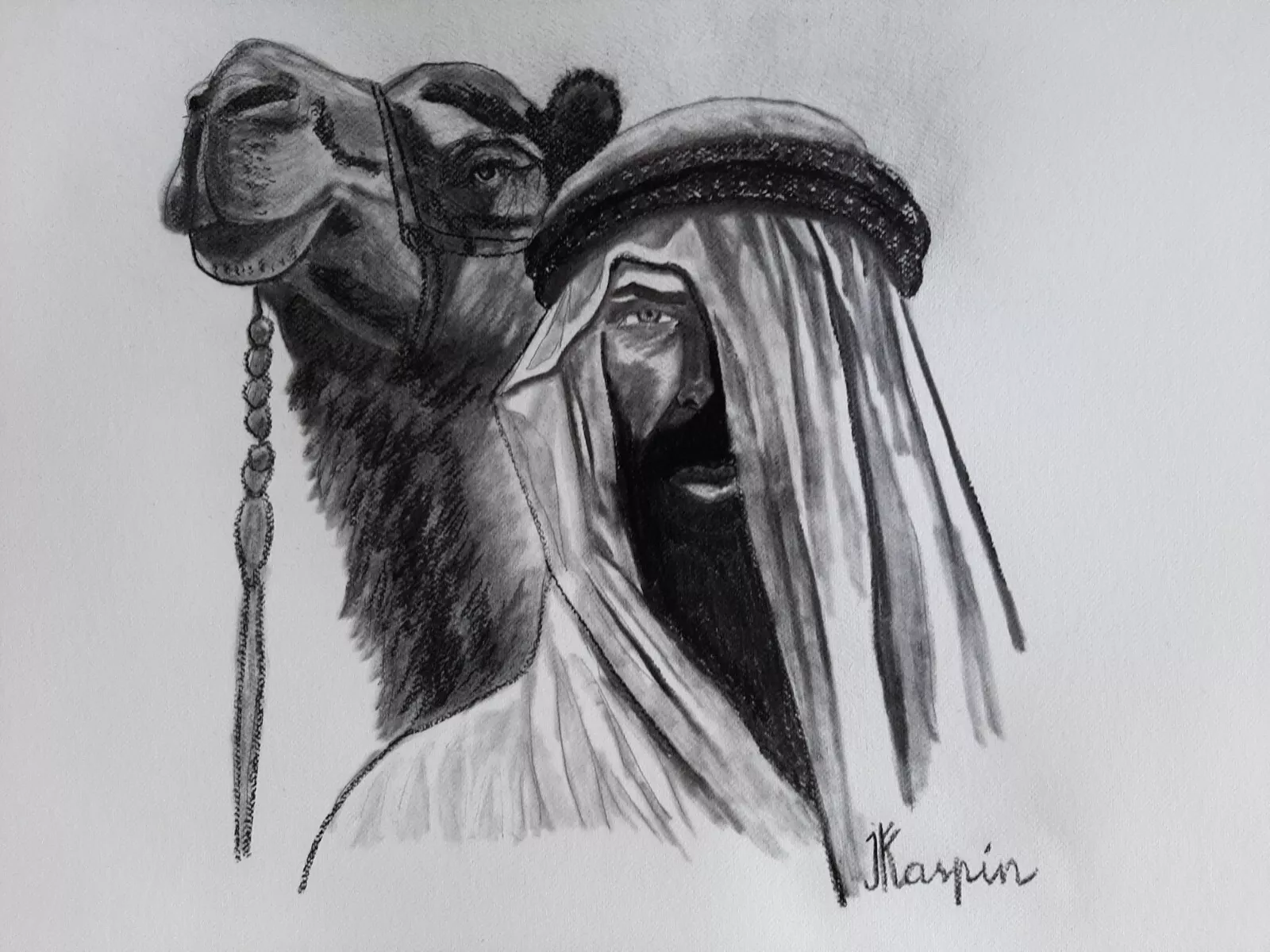
L’œuvre se distingue par une maîtrise remarquable du noir et blanc, où chaque trait semble chargé de mémoire et de silence. Ce dessin, à la fois sobre et intensément expressif, transcende la simple représentation pour devenir une évocation poétique du lien entre l’homme et le désert. Le choix du médium monochrome n’est pas anodin : il dépouille la scène de toute distraction chromatique pour mieux en révéler l’essence. Le regard du camel, tourné vers l’homme, semble habité d’une sagesse millénaire, tandis que le visage partiellement ombré du personnage, encadré par le keffieh et l’agal, suggère une intériorité profonde, presque mystique. L’artiste joue subtilement avec les contrastes pour créer une tension visuelle entre la présence imposante de l’animal et la retenue méditative de l’homme. La composition est équilibrée, presque cinématographique. Le vide autour des sujets n’est pas absence, mais espace de résonance : il évoque les vastes étendues désertiques, le souffle du vent, et cette solitude habitée qui caractérise les grands voyageurs du silence. On sent dans ce tableau une influence orientale, mais jamais folklorique — c’est une vision respectueuse, intime, qui parle d’identité, de mémoire et de spiritualité. Enfin, la signature « Ikaspin », discrète mais affirmée, vient sceller l’œuvre comme un murmure d’auteur. Ce tableau n’est pas seulement une image : c’est une méditation visuelle, une porte ouverte sur l’âme nomade.
********************************
The wind drifted across the dunes like a forgotten caress. The sun, already low, painted the horizon in shades of amber and ash. He walked slowly, his keffiyeh trailing behind him, guiding his faithful companion—a weathered camel with eyes that had seen lifetimes. Together, they crossed the silence of the desert, not to escape, but to remember.
Her name was Layla. A star among grains of sand. They had met in a bustling souk, alive with color and scent, where voices tangled like threads of gold. She spoke of poetry, of love as a mirage—visible, but untouchable. He had loved her without possession, the way one loves the sky—with reverence and awe.
Each evening, he returned to the place where the wind whispered her name. He spoke to his camel as one speaks to an old friend, sharing fragments of memory the heart refused to let go. The desert never answered, but it listened.
And in that silence, he found a kind of peace. For love, when true, does not vanish. It becomes sand, wind, light—a presence unseen, always watching.
Beneath the veil of desert skies,
Where silence sings and time denies,
He walks alone, with shadows near,
A camel pacing dreams sincere.
The wind recalls a name once sweet,
A love that vanished in the heat. Her eyes,
like stars, still haunt the night,
Her voice, a ghost in fading light.
He speaks to sand, to stone, to air,
To Layla, lost, yet everywhere.
The dunes reply in whispered tones,
Of longing carved in ancient bones.
No map can trace the heart’s terrain,
No compass guides through love and pain.
Yet still he walks, through dusk and flame,
A soul in search of just her name.
J.Kaspin and the Soul of the Desert
This work stands out for its remarkable mastery of black and white, where each stroke seems imbued with memory and silence. The drawing, both understated and intensely expressive, transcends mere representation to become a poetic evocation of the bond between man and desert.
The choice of monochrome is no accident—it strips the scene of chromatic distraction to reveal its essence more clearly. The camel’s gaze, turned toward the man, appears to carry millennia of wisdom, while the partially shadowed face of the figure, framed by the keffiyeh and agal, suggests a profound, almost mystical interiority. The artist subtly plays with contrast to create visual tension between the imposing presence of the animal and the meditative restraint of the man.
The composition is balanced, almost cinematic. The emptiness surrounding the subjects is not absence, but resonance—evoking the vast desert expanses, the breath of the wind, and that inhabited solitude characteristic of great silent wanderers. One senses an Eastern influence in this piece, but never folkloric—it is a respectful, intimate vision that speaks of identity, memory, and spirituality.
Finally, the signature “Ikaspin,” discreet yet assured, seals the work like an author’s whisper. This drawing is not merely an image—it is a visual meditation, a doorway into the nomadic soul.
— Dr. Éléonore Varenne, historienne et critique d’art contemporain